• Skip to main content

089 4612537

info@fingalspca.ie

SUPPORT OUR WORK
  • About Us
    • Report Animal Cruelty
    • Financial Regulation
    • Complaints Procedure
  • Needing Homes
  • Lost & Found
  • How You Can Help
  • Useful Info
  • Blog
  • Contact Us
  • Disclaimer
FSPCA current logo - circle

Fingal S.P.C.A.

Fingal Society for the Prevention of Cruelty to Animals

News

What to do if you found a stray dog or puppy?

April 27, 2023 by Andrea

What to do if you found a stray dog or puppy?

  • Have a good look at the dog to see if it has been injured before you touch it, animals in pain can bite
  • Check if it has an ID tag, and ring the number if it does
  • Bring it to the nearest vet to scan it for a microchip
  • If possible take a photo and do up a ‘found’ poster, giving a description of breed, sex, age, colour, collar colour, if it has any disctinct markings, and the area you found it in.
  • Report the dog to the local Garda station and pounds.
  • Put up posters in local vets, pet shops, and newsagents.
  • Post it on local Lost & Found Facebook groups, like  Lost and Found Facebook group.
  • Please look for proof of ownership if you are contacted about a dog you have found by a potential owner.

Unfortunately the Fingal SPCA have no premises so cannot take any strays into our care.  We would have to pay for any stray to be kennelled until it can be reunited with it's owners or rehomed.

Stray Dogs and the Law

It is a legal requirement to comply with The Control of Dogs Acts and report any stray dog to the dog warden.  Even places such as the Dogs Trust have no authority to keep stray dogs under The Control of Dogs Acts 1986 and 1992.


Source: Dogs Aid & Dogs Trust

Stray dog looking back on road

Filed Under: News Tagged With: puppy found, stray dog, stray pup

Reporting Animal Cruelty

March 16, 2023 by Andrea

Reporting Animal Cruely

The Agriculture, Food and the Marine now have a dedicated division for Animal Welfare and a full team dedicated to animal welfare both farm and domestic.
They have a phone/email as a direct contact for members of the public to report suspected
animal abuse, which is manned during working hours.
Call Save: 0761 064408
Phone: +353 1 607 2379
Email: animalwelfare@agriculture.gov.ie
www.agriculture.gov.ie/animalhealthwelfare/

Monday to Friday (excluding Bank Holidays). At all other times it will divert to a recorded message and messages left will be monitored regularly.

The GPS code or Eircode will be requested of the suspected incident in order to track it efficiently and they will also ask for the phone number of the complainant. But rest assured all animal welfare reports are processed in the strictest confidence.
report animal cruelty

Filed Under: News Tagged With: education, news, updates

Found a Hedgehog?

March 29, 2021 by Andrea

Found a Hedgehog?

Have you found a hedgehog?

How do you know if it needs to be rescued?  Well if you answer yes to any of the list below then yes it does need help:

  • Road traffic casualty
  • Out during the day
  • Unresponsive but not in nest (hedgehogs only hibernate in nests)
  • Damaged limb/s
  • Limb protruding when curled up
  • Underweight at wintertime (under 600g by November)
  • Obvious wounds
  • Injured baby hedgehog (often making high pitched pipping sound)
  • Baby hedgehog if it’s on its own, and only after lengthy observation from a distance
  • Trapped or caught e.g. down a drain / in fencing – do not cut free and release
  • If unresponsive/unconscious – needs veterinary attention immediately

If you accidentally uncover a hibernating hedgehog, please don’t move it. Cover it over again with a thick layer of dry leaves and leave it to sleep. Put some water and some dry or wet cat/dog food (non-fish based food) nearby in case you have woken it up and it comes out of hibernation. Please do not give it bread or milk.

Initially, we ask you watch the hedgehog to see what it does for a short time. Please do not pick up a healthy-looking hedgehog unless you have concerns.

If you are still concerned about the hedgehog, pick it up (wearing gardening, or thick, gloves), put it in a high-sided cardboard box/cat carrier/hamster cage. Line the box with an old towel/fleece at the bottom for it to hide in and keep warm (or plenty of newspaper if you have nothing else). Put down more water and cat/dog food and put the hedgehog somewhere quiet, dark & warm. Please keep away from children and domestic animals.

For hedgehogs who need our help, please call, or text Hedgehog Rescue Dublin on 086 881 0492, as soon as you can. If you don’t get a respond right away,  please keep trying as they might be out on a hedgehog rescue, or on feeding duty and may miss your first attempt.

Our thanks to Hedgehog Rescue Dublin for this invaluable information.

HedgeHog Rescue Dublin

Hedgehog Rescue Dublin, based in150 150 logo Rush, are a non-profit organisation, dedicated to rescuing sickly, orphaned and/or injured hedgehogs in the Leinster area.
Their ultimate aim is to return hedgehogs back into the wild once we have nursed them back to full health. They do not rehome hedgehogs to the general public, but have a number of safe wild habitats where they release the hedgehogs to live out the rest of their lives.

You can contact Hedgehog Rescue Dublin on 086 881 0492, on Facebook or via their website

Filed Under: News

Foster for us

February 24, 2021 by Fingal SPCA Volunteer

Can you Foster?

Would you consider becoming a temporary fosterer to an animal?

We rescue all sorts of animals: dogs, cats/kittens even budgies and as we don’t have a physical shelter, all the animals we rescue are taken into either kennels/catteries or the homes of our foster volunteers until a permanent home can be found.

We are always looking for more foster homes because the more places we have available, the more animals we can take in and help.

Sometimes it may be that you have considered adopting an animal but feel your current lifestyle just doesn’t suit a long term commitment? Or maybe you’re not sure how you and a pet would get on? Fostering is an ideal way of helping an animal in need and gaining valuable first hand experience of owning a pet.

A loving foster home works wonders for any animal who has experienced abandonment and a tough start in life.  A loving foster home can allow them to become socialised and develop into a friendly contented animal, while they wait for their new forever home.  So if you have a secure premises and a lot of love, then fostering could be for you.

We cover all veterinary costs and supply food and litter.  Advice and backup is always on hand.

Send us an email and let's talk

Yes I'm interested in fostering

Filed Under: News

Volunteer

February 19, 2021 by Fingal SPCA Volunteer

Volunteer

Become a Volunteer

The Fingal SPCA is comprised entirely of volunteers. They are the lifeblood of our organization and the reason we are able to offer services to the animals who need our help each year.

In particular, we are seeking volunteers to help with rescuing animals by catching wild cats and bringing them to the Vets for spaying or treatment. This helps reduce the overpopulation of stray cats and promote better health and quality of life for the neutered male and spayed female.

Our problem a lot of the time is lack of manpower in getting the traps to the areas needed.

We would love to have more volunteers in the Fingal area to help us continue with this vital work.

Training will be given but you will need a car or van. Limited petrol expenses available.

If you are interested in learning more about becoming a volunteer please contact us on 089 461 2537 or by email

Yes I'm interested in volunteering

Filed Under: News

Stray cat in the garden

February 8, 2021 by Fingal SPCA Volunteer

What to do about a stray cat

You may have noticed stray cats in your garden.  If they seem to have no other home, they may be a wild cat.  A wild cat is merely a domestic cat who has been born and raised without contact with humans.  Or a cat who has not had contact with humans for a significant period of time and has become unsocialised.

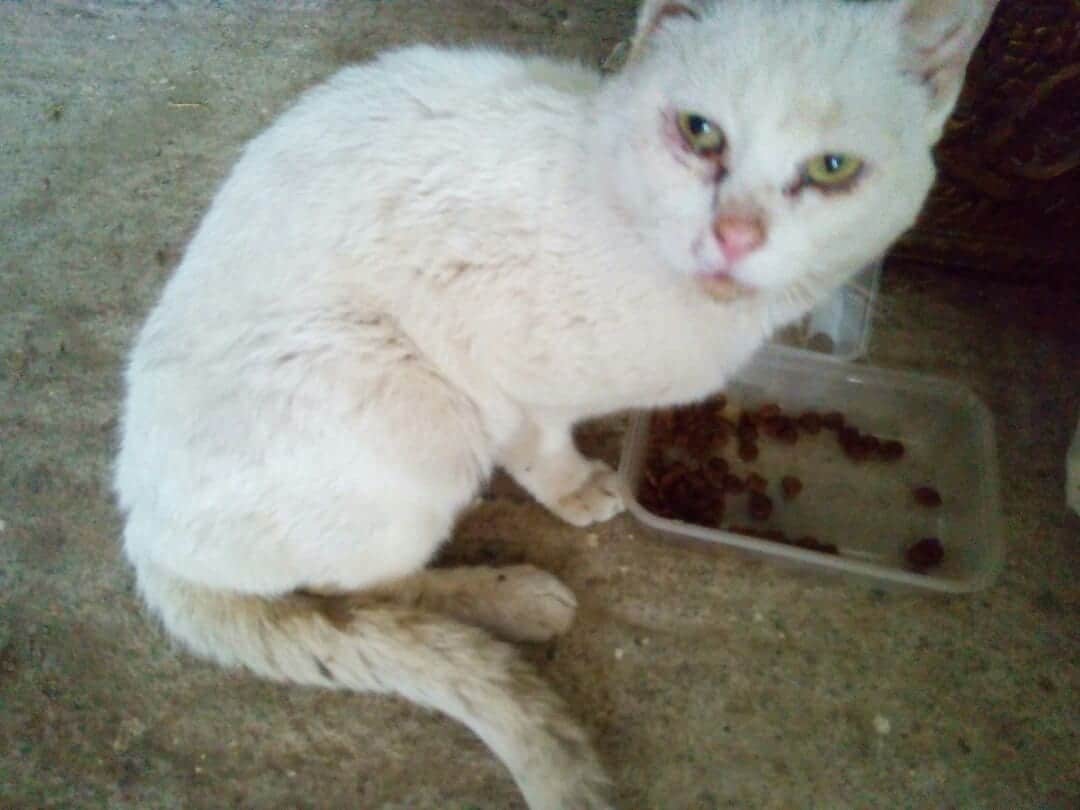
Usually this happens when they are dumped by owners no longer willing or able to care for them.  Others have been left behind when their owners moved house or passed away.  Some are lost.  Many will have reverted to a wild state in order to survive.  Their offspring will be wild as they will not have had interaction with humans.  These cats endure a very difficult life, often struggling to survive in sometimes harsh conditions with not enough to eat on a daily basis, a lack of adequate shelter from the elements and with no access to veterinary treatment.  All are trying to survive as best they can.

If you would like to help wild cats in this situation we need to:

19578604_10155368897184178_482273259_o

Spay/Neuter

  • One female cat and her offspring can be responsible for a colony of 30 cats in an area in just one year.
  • A Trap/neuter/return (TNR) policy will prevent more cats from being born and the numbers increasing.  Too many cats in an area can cause problems, particularly neighbourhood disharmony, so it’s vital their breeding is stopped and their numbers contained as soon as possible.
  • Regardless of how wild a cat is, humane traps are available to trap them for transportation to a vet where they are spayed/neutered, treated for parasites and after a recovery period returned back to their location to continue to live and be fed by caring individuals.

The Fingal SPCA offers such a service so if you think a wild cat is in your area, please contact us on 089 461 2537 or by email.

Feed Regularly

  • Access to food on a regular basis is vital to ensure they survive and thrive.  If you have cats in your area or workplace, feeding them once or twice daily will be ideal.
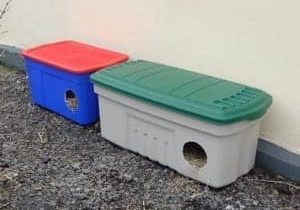
  • Or you can set up a feeding station.  A gravity feeder which will keep dry cat food fresh for several days, can be placed inside a plastic storage container with a hole cut out to allow the cats access. Place it out of public view to prevent it being stolen or tampered with.
  • Feeders come in various sizes to allow cats to eat for several days before the food runs out.  Read more on setting up a feeding station for cats. More idea for feeding stations here.

Provide Shelter

Shelter

Shelter is vital for wild cats to help them survive the winter weather.  If cats are coming into your garden, consider allowing them to shelter in a shed or garage via an open door or window or cutting a cat sized opening in a door or installing a cat flap. A dog kennel is another option. Simple beds made with plastic containers lined with straw are easy to keep clean and the straw is inexpensive to replenish.

Cheap weatherproof shelter such as styrofoam boxes can be set up very easily.

These boxes are available from restaurants, fish shops, vets, hospitals etc. Simply cut out a cat sized hole in the box, tape the lid on, cover with a heavy duty refuse sack and line with straw to make a cosy shelter that the cats will appreciate.  Place out of public view and weigh down with rocks or bricks on top. Check the boxes regularly and replace the straw when necessary.

Click here to see further Examples of shelter boxes.  We would recommend that these types of boxes are used in domestic, garden settings only. We can provide kennel type shelters if required, please contact us to discuss.

Litter Trays

To keep your garden and area clean, providing a litter tray is a good idea. Provide covered litter trays or sand/compost boxes in an appropriate area and clean regularly.

Our thanks to Feral Cats Ireland Organisation for this information.

Filed Under: News

  • « Go to Previous Page
  • Page 1
  • Page 2
  • Page 3
  • Page 4
  • Go to Next Page »

Get In Touch!

089 4612537

info@fingalspca.ie

About Us

Registered Charity No: 19192
Charities Regulator No: 20074975
Dept of Agriculture Registry No: FPT2000020C

© Fingal SPCA 2015 -  2026. All Rights Reserved.